

The important and pertinent legal issue which this article addresses is whether provincial High Courts exercising original company side jurisdiction under the erstwhile Companies Act’ 1956 in winding up petitions in which only provisional liquidator has been appointed with no permanent liquidator and / or any order for winding up / permanent winding up not having been passed will continue to exercise jurisdiction or whether the same will cease wherein in cases against the same company / corporate debtor, corporate insolvency resolution process [C.I.R.P.] u/s 7 or even u/s 9 of the Insolvency and Bankruptcy Code, 2016 [‘code’ for short] has been initiated.
In short, the precise and pertinent question which arises for discussion and deliberation is: “Whether the NCLT can entertain a petition by a creditor of a company / corporate debtor u/s 7 or 9 of the Insolvency and Bankruptcy Code, 2016 after the order of admission or appointment of Provisional Liquidator by a Company Court / High Court but before appointment of liquidator / permanent liquidator which is after the order for winding up / final winding up?”
A final opinion and conclusive view was needed on this ambiguous position of law which has come after the enactment of the Companies Act, 2013, the Code of 2016 and the step by step repeal of the Companies Act’ 1956 as there are many cases caught between this divide at the moment and the dichotomy and the ambiguity in the law needed to be settled, if any.
The Hon’ble Supreme Court of India in the case of M/s Forech India Ltd. Vs. M/s Edelweiss Assets Reconstruction Co. Ltd., reported as 2019 SCC On Line SC 87 has addressed the afore stated issue.
The proviso added to Section 434 of the Companies Act’ 2013 vide amendment dated 6.6.2018 enables the High Courts to transfer proceedings to the NCLT upon application by a party. Vide this proviso the intent of the legislature is evident that it intended NCLT to be adjudicating all company related insolvency issues. That vide amendment dated 06.06.2018 i.e., ‘The Insolvency and Bankruptcy Code (Amendment) Ordinance, 2018′ No. 6 of 2018, in sub-section (1), in clause (c) of Section 434 of the Companies Act’ 2013, after the proviso, a fresh proviso had been inserted whereby it has been provided that parties may apply before the Court where winding up proceedings are pending for transfer of the proceedings to the NCLT / the Tribunal. That from the afore stated amendment there was never any bar or impediment as far as the jurisdiction of NCLT is concerned.
The said proviso clearly shows the intention of the legislature which is to have all matters of such nature for adjudication before the NCLT under the Code which is a more modern, advanced, evolved and competent mechanism to deal with corporate debts and insolvencies.
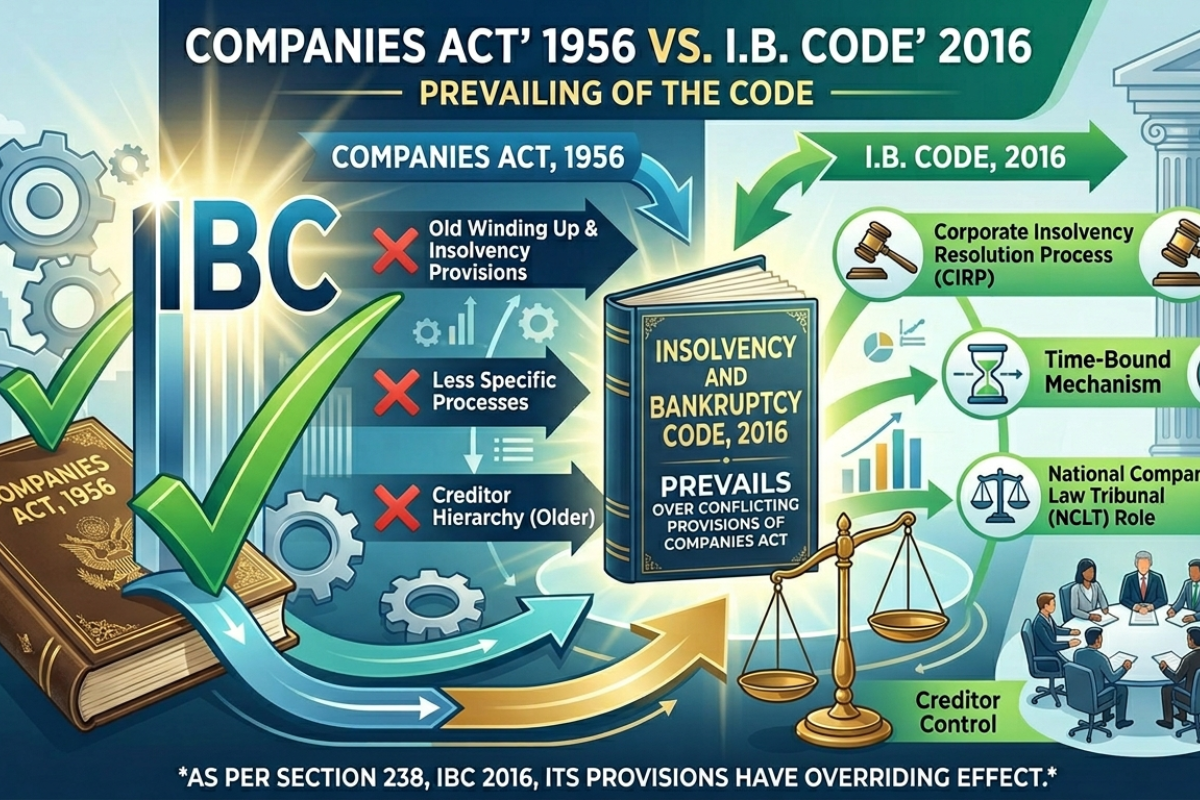
The notable difference between the two is that in a winding up petition under the Companies Act’ 1956, the only mandate is to liquidate the company which may not always serve the best interests of all creditors and parties whereas under the Code the mandate is two-fold with the initial and primary focus to revive / rehabilitate / restructure the company and if the same fails then to liquidate the same. Though restructuring was provided for under liquidation proceedings under the 1956 Act as well however the same was toothless, hardly effective and not widely used.
The CIR process is also time bound (180 days with maximum up to 270 days) and as such takes much lesser time in comparison to winding up under the Office of the Official Liquidator attached to a particular High Court.
Reference is also invited to the decision(s) of the Hon’ble Bombay High Court in M/s Jotun India Pvt. Ltd. Vs. M/s PSL Limited, 2018 SCC OnLine Bom 36 and in M/s Ashok Commercial Enterprises Vs. M/s Parekh Aluminex Limited, 2017 SCC OnLine Bom 421 which was upheld by the Ld. Division Bench also of the said High Court in the matter of M/s Jotun India Pvt. Ltd. Vs. M/s PSL Limited, 2018 SCC OnLine Bom 1952.
The following points recap / highlight the issues considered and decided in the afore said two cases: I.B.C., 2016 is a later and special statute dealing with the subject of the insolvency resolution of corporate persons in a time-bound manner for maximization of value of assets of such persons and to balance the interests of all stakeholders, and is a successor statute to S.I.C.A., 1985. The Companies Act, 1956, which is an earlier statute must give way to I.B.C., 2016.
Besides, Section 238 of I.B.C., 2016 contains an overriding provision. There being no similar provision in the Companies Act, 2013, the provisions of I.B.C., 2016 must prevail over the provisions of Companies Act, 2013.
That the intention of the legislature is clear from the transfer notification dated 7th December 2016 that both proceedings, i.e., the winding up and NCLT proceedings can continue simultaneously.
Section 63 of I.B.C., 2016, bars jurisdiction of Civil Courts to entertain proceedings on the issue over which N.C.L.T. has jurisdiction. This Section is pari-materia to Section 34 of SARFAESI Act, 2002. Section 231 of I.B.C., 2016 specifically curtails the power of Civil Courts or any other authority to restrain any action taken or to be taken before N.C.L.T. This clearly curtails the power of the Company Court / High Court to pass any injunction qua any pending I.B.C., 2016 Application before N.C.L.T.
There is an express bar against any court granting any injunction in respect of proceedings before N.C.L.T. The statutory bar against a corporate debtor from filing an application under section 10 of I.B.C., 2016 operates, if and only if, there is an order of liquidation against the corporate debtor.
I.B.C., 2016 has been enacted to revive the Corporate Debtor by declaring a Moratorium of various proceedings and appointing an Interim Resolution Professional (IRP) to manage the affairs of the Corporate Debtor. Similarly, both S.I.C.A., 1985 and I.B.C., 2016 contains non-obstante provisions to the effect of overriding the provisions of any other law in force except as excluded expressly. There is in fact no inconsistency between the provisions of I.B.C., 2016 and Companies Act. However, in the event of any inconsistency, the provisions of I.B.C., 2016 will prevail in view of Section 238 of I.B.C., 2016.
The Hon’ble Supreme Court’s conclusive and authoritative opinion and view was needed on this ambiguous position of law which has come after the enactment of the Companies Act, 2013, the code of 2016 and the step by step repeal of the Companies Act’ 1956 as there are many cases caught between this divide at the moment which has been given.
BY: MAREESH PRAVIR SAHAY, ADVOCATE
Credits: Judgments pronounced by the Hon’ble Supreme Court of India and Hon’ble High Court of Bombay.
The Author is an Advocate-on-Record with the Supreme Court of India. The views expressed are personal.